
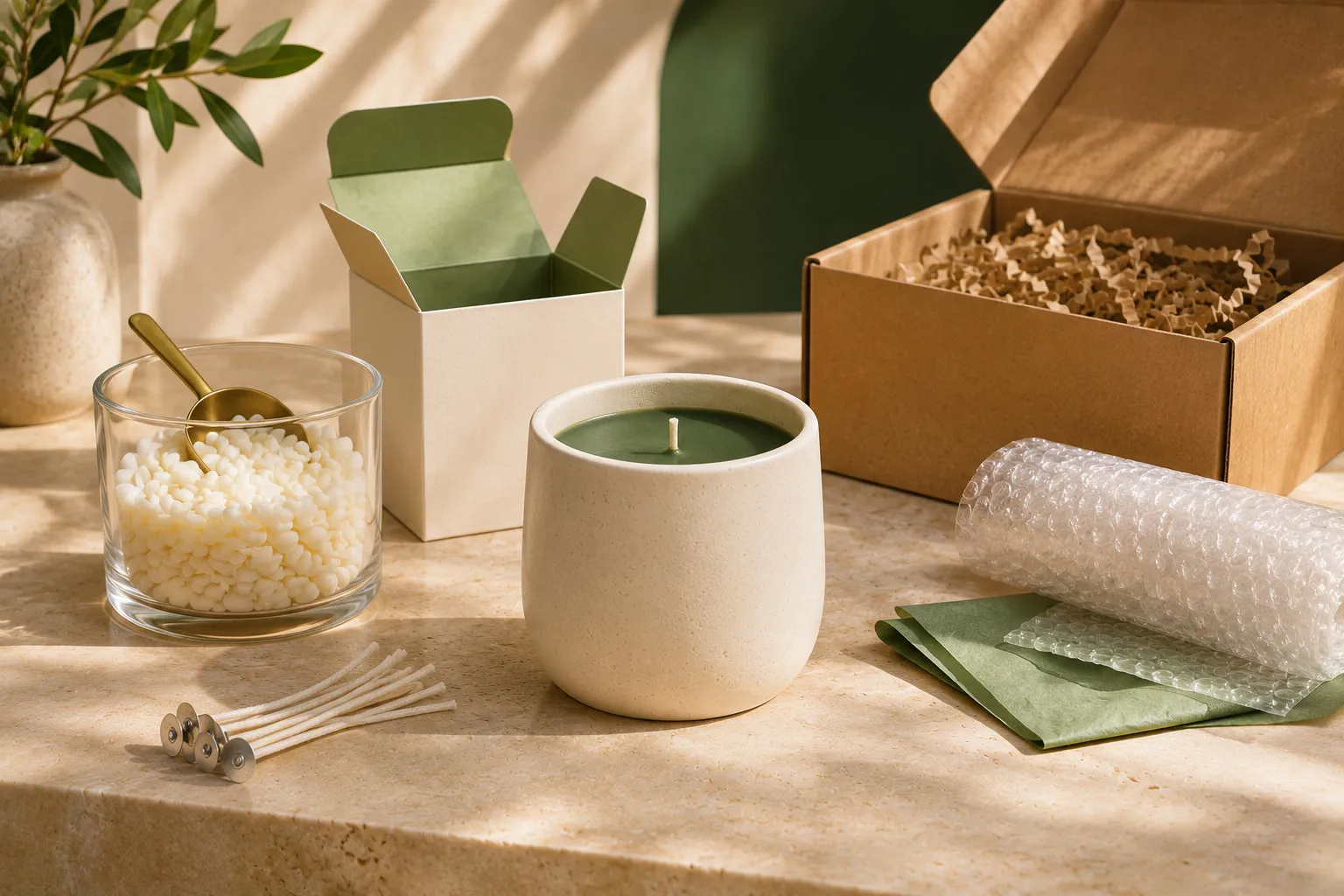
If you make and sell things by hand, such as candles, soap, prints or jewellery, the most common pricing question is “what should I charge?”. It can’t be answered until you know what one item really costs you. That number is usually higher than the price of its materials.
This guide walks through every cost that belongs in it, using a candle as the example. The numbers are made up for illustration; use your own.
1. Materials, per item
Work out what goes into one finished item, not what you paid for a bulk bag.
| Material | Bought as | Used per candle | Cost per candle |
|---|---|---|---|
| Wax | 2 kg for 18.00 | 180 g | 1.62 |
| Fragrance oil | 100 ml for 9.00 | 12 ml | 1.08 |
| Wick | 100 for 6.00 | 1 | 0.06 |
| Vessel | 12 for 30.00 | 1 | 2.50 |
| Materials total | 5.26 |
The method: price paid ÷ quantity bought × quantity used.
2. Packaging
Everything the customer receives that isn’t the product: label, lid, box, tissue, filler, tape, a thank-you card. These are easy to forget because they feel like “supplies” rather than part of the product.
Example: label 0.20 + lid 0.35 + box 0.60 + filler 0.15 = 1.30
3. Waste and testing
Not every unit comes out sellable. If, on average, one in twenty candles has a flaw, each good candle has to carry a share of the failed one’s materials. A simple way to allow for it is to add a small percentage to materials based on your own failure rate.
Example: 5% of 5.26 = 0.26
4. Selling and payment fees
Marketplaces, online shops and payment processors usually charge per sale, often a percentage of the price, sometimes plus a fixed amount. Rates vary by platform, country and plan, and they change, so look up the current fee page for the services you actually use rather than relying on a figure you read somewhere.
Because these fees depend on the selling price, add them last (see step 7).
5. Your time
This is the cost most makers leave out, and the reason many feel busy but unpaid. Time your work across a batch (melting, pouring, curing checks, labelling, packing) and divide by the number of items.
Example: a batch of 12 takes 3 hours → 15 minutes per candle. At an hourly rate you choose of 15.00, that’s 3.75 per candle.
Choosing the hourly rate is a personal decision. The point is to put a number on it, so that you can see whether your price actually pays you.
6. A share of overheads
Some costs aren’t tied to one item but exist because the business does: equipment, a thermometer, moulds, website or shop subscriptions, test batches for new scents. Estimate them for a month and divide by how many items you expect to sell that month.
Example: 40.00 of monthly overheads ÷ 80 candles = 0.50 per candle
7. Put it together
| Cost | Per candle |
|---|---|
| Materials | 5.26 |
| Packaging | 1.30 |
| Waste allowance | 0.26 |
| Your time | 3.75 |
| Overheads | 0.50 |
| Cost before selling fees | 11.07 |
That 11.07 is the floor: sell for less and you’re paying to make the candle. Your price then needs to cover this cost, the selling fees on that price, and a margin for the business itself, which is what pays for growth, mistakes and quiet months.
A practical way to check a price you’re considering:
- Take your intended price.
- Subtract the platform and payment fees at that price, using the current fee pages.
- Subtract the 11.07 cost.
- What remains is your margin per item. Is it enough?
A few things worth knowing
- Recalculate when supplier prices change. A small rise in wax or vessels changes every item you make.
- Shipping is its own question. Decide whether postage is charged separately or included in the price, and price accordingly.
- Costs are not the same as price. Customers pay for quality, design and trust too, but knowing your true cost tells you the lowest price that still works.
Knowing what one item really costs won’t set your price for you. It does make sure you set it knowingly, not by guesswork.
General information only, not financial advice.